(Woah, it's been a while since I've updated this site.)
Read that my new years resolution, that I've seemed to have forgotten, was to start a campaign. I should really refocus on that. The players and rulesystem is still up in the air, but its down to either a traditional fantasy (Pathfinder) or dystopian cyberpunk (Eclipse Phase). To be honest, I would rather play a game of Eclipse Phase before running one. As well, Pathfinder is a nice game to get a group together with.
In the world, deities are plenty. Temples and shrines are scattered to worship the myriad of deities, however worshipers never learned their names. Only the highest priests and priestess have learn the names of their deity, and such knowledge is kept secret. With such secrets, the deities are best acknowledge by the form they take and the profession they appear as.
Lorekeepers debate the reason for this and blame the events that lead to Second Age of the world, the age when the world was cover in darkness and cataclysm. During the first age, the deities had direct connection to the world and help bring prosperity to all facades of the world. The people of the world grew pampered and arrogant from the gods' presence. The gods felt necessary to remove themselves from the world, and the world entered the Second Age when a star fell to the ground.
After centuries of turmoil, the deities return to guide and influence the world. Taken only mortal forms, they stayed anonymous in their actions. They also began appearing as visions to wise men and leaders, allowing monuments and temples to began to appear again across the world. Even when they grew notable and return to the world, they kept their names to themselves.
Well, with me growing up on AD&D. I thought cantrips and level 0 spells to be relative weak. Not in Pathfinder though.
Any class with Orisons or Cantrips has a steady supply of magic they can use. Casting 0-level spells don't use the memorization. Classes that prepare their spells memorized a list of 0-level spells, and then they can continue to reuse those spells over and over. The other classes (Bard and Sorcerer) that don't prepare just can cast any of their cantrips at anytime.
So for example, a cleric memorized Create Water, Light, and Stabilize. That cleric will always have the option to cast those spells... no matter how many times he casts them. However, if he needs to cast Virtue, he must rememorize a new list of spells. A more combative example is a wizard having Acid Splash as a memorized cantrip, each turn he can use his magic to deal damage in combat.
This ability makes magic-users always have a means to cast spells, and they never drain all their powers like in prior versions of AD&D.
Gunpowder isn't unheard in the world, however most realms only see it as a novelty. Alchemists had stumble across the mixture making blackpowder, but little has found a suitable application to the substance. The majority is used for entertainment purposes, such as fireworks, but a few engineers managed to design devices to transform blackpowder into weaponry.
Such weapons are a rarity throughout the world, many see them as trinkets and curio pieces. Only a few realms produce the weaponry for military purposes, the most well know is the Dwarven Halls of Felsite. Locked in a war with several goblin tribes lead by a fierce warlord, outnumbered and surrounded the dwarves designed the first reliable muskets. From behind they're thick stone fortresses and the ingenuity of dwarven tinkerers, they repelled the goblin hoards. However, this knowledge of gunsmithing remained a secret within the halls of Felsite, but tales of the firearm's abilities spread through the realms.
As alchemist and engineers attempt to recreate their own version of the musket, only a few inventors met success. And even then, many lords didn't accept the idea of using them in there armies. The risk of the blackpowder exploding on there own men, and complexity of the devices swayed lords to dismiss the weaponry in favor to practical crossbows and pikes. Only a few nations accepted the idea, but only to the less complicated larger cannons and mortars in means of protecting their fortresses and ships.
With most rejection from the lords, inventors either kept their secrets to themselves or formed small guilds to supply private groups with weaponry or the masses with common fireworks. Out of the guilds, a few of venture out to the world and bringing their personally firearms to face the world for glory and treasure. These few are known as "Gunslingers". Gunslingers are rare to find, but tales of their deeds are sometimes confused with sorcery from the unknowing, the fire and smoke they produce often mistaken with the magic of the arcane.
The Gunslinger class (in the Ultimate Combat book) is open for players to pick. Available freely at the character's start, but cannot be gained in game unless special circumstances are ment, either coming across another gunslinger or gunsmith that will be willing to train you or the coming across a firearm in your travels.
Another thing, guns are rare. You will more often be spending the 1,500 GP for a basic musket due to that fact. Suppliers are rare and demand is slim in the world, forcing gunslingers to upkeep and repair the guns themselves. With guns only emerging in the world, advance weapons (like rifles) are unheard off or even don't exist, and only the early firearms and simple cannons are available in the world.
Most rules are addressed in the book: firearms are consider exotic, rolling a within the misfire range gives the weapon a broken condition (or explodes if already broken), Gunslinger start with a broken firearm, etc etc.
And sidenote: since I looked into the Ultimate Combat book, I'll say it now: no, you can't be a Ninja or Samurai. A Ninja is just a Monk/Thief and a Samurai is a eastern Cavalier. No 'ifs', 'ands', or 'buts' about it.
I only reference the book for rules on firearms and the Gunslinger class cause I admire the idea and appeal of early firearms, and allowing players the option to pursue such characters concepts and me the ability to incorporate blackpowder to the setting. Anything else in the book is up to debate, but I'll primarily use the core book for the majority of rulings.
And talking about emerging gunpowder, let's watch this trailer:
Traps are often designed for one purpose: to kill and/or capture trespasser. That s a pretty easy concept to understand with it comes to trap design. Now, the question is: where will you find them?
Traffic is a big deal for trap design. In a dungeon that will have lots of the inhabitants moving about, you won't find many traps scattered though out the halls. And if they were traps, all would be linked to arming switches to provide a measure of safety for in the inhabitants. High traffic areas will probably only have traps at entrances or vaults, or built into important chests most won't open.
Upkeep and maintenance plays a role in trap design as well. In an abandon keep or dungeons, some traps may have already been sprung by prior adventurers, or the time decay to in can't be used. Gears rust and ropes fray without some keepers tending to the traps to ensure their working order.
Probably the biggest place to find traps is in the areas no one should be venturing into. This most being scared tombs, hidden vaults, and the such. Such locations could have traps in every corridor.
Traps make a dungeon more a challenge, as well as entertaining. Traps harm, hinder, or even leave characters confused (see 'idiot buttons'). As well, puzzles are often intergrated with traps, allowing players to match wits with the dungeon instead of simple cunning or skill.
Let talk a few rules behind traps though... game-mechanics that is. Pathfinder and in its ingenuity, finding traps only take a Perception check. Anyone can make Perception checks, and then anyone can find traps. The only plus that Rogues have is that they add half their Rogue level to finding traps, as well as Search is a class skill. Rogue also have a better chance to disarming traps to, since they get a modifier just like finding them. Plus Trap-finding ability allows Rogues to be able to disarm magical traps, non-Rogues cannot.
Another thing about trap-finding is how GM's deal with it. One DM we had made our Thief roll for each square as we traveled. It slowed the pace of gameplay and aggravated the Thief's player to the point of saying 'Fuck it' and let the douche cleric take the lead.
In both 3.5 and Pathfinder, there is a rule that settles this... called "Taking 10", and it goes to all times of skills. It simply stats: If there is no risk in the environment and the character can take his time, he can treat the check as rolled a 10 and add his modifers. This means if the characters are not in conflict or not rushed, ie: running from death, the player can always be counted as rolling 10 plus any relating modifier. So the Thief in the prior incident could simply state, "I combing the area carefully as we make our way though the halls." The DM should translated it as Taking 10, just to quicken the pace. The thief would've been searching with the result of 17-ish as he walked, and whenever an item is found, the DM could either alert the Thief and allow him to closer inspect the area, or provide a Reflex test... depending on situations.
(Personally... I feel the DM's handling of the game (as well as his campaign) was done wrong. But that's personal opinion.)
With the Taking 10 option, it just helps streamline dungeon encounters. Let alone, Pathfinders approach allows the ability of surviving a dungeon with traps without a Rogue being in the party. A variety of characters can find traps, be it any individual with Perception or anyone with divination spells. All which allows parties not to depend on a Rogue to do such tasks.
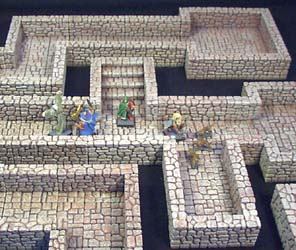
Been fooling around with plans for a modular dungeon piece set, and figured out what pieces would be a useful start. But before I begin, better think of the pro's and con's of such a task.
The major pro for dungeon pieces is that they provide a third dimension to the dungeons and ruins (or even space hulks) that the characters and players are exploring. It just looks better than the map drawn out on a dry-erase sheet, especially from a modeller's point of view. Some people I play with just do better with physical representations of combat and such, and an actually 3d representation of such environments is useful.
The two major drawbacks however is the lack of flexibility of pieces and the price tag. With only a set of pieces, you can only arrange the pieces a certain number of ways, or have rooms be only a certain size till you decide to make a new piece to meet the requirements you want. And second, the number of molds to make a plain set (like the picture above) is $80 plus the paints and base materials. To make a decent, and varied set of pieces, you will probably be spending $200 on molds plus all the base materials. Then, the time to cast all the blocks.
Building a dungeon piece set is a lengthen project, but can still merit a sense of accomplishment if done right. But till I can afford it, it's gonna be dry-erase grid sheets.
While getting use to the systems, and eager to test out a few random encounters I have. I made a trio of characters to test out things, a mix of everything (except brawn) and been playing though the early level encounters that can occur in the sewers.
The first was 4 dire rats, and it went as expected. Two of the three were diseased, but no real damage was done.
Shit hit the fan when I decide to test out the cockroaches. 6 giant cockroaches versus three adventures... and it was tough. Everyone was knocked down to 2-3 HP and the thief was unconscious. The big thing the cockroaches had on there side was each having 7+ HP and being Die Hard. They will always be at 0 before they die, and that gives each one a last attempt to attack before they die. And I fudge the Die Hard feat since it seems awkward (that is if I read it correctly)... I don't see a cockroach staggering till he reaches -18 HP. So, for creatures and encounters... I'll be treating Die Hard differently... with any blow taking the creature below 0, just takes it to 0 and staggers.
Also, another thing I learn is the cleric's Channel Energy ability. It affects everything within the area... be it friend or foe, living or dead. The user can declare if he/she is affected by it as well. Making my cleric's Channel Negative Energy ability a last ditch ability, unless she's separated from the party. This also makes the other channel feats (like Selective Channeling) pretty useful. But still... 1d6 damage to everything within 30' of a person is a nasty ability at first level.
Last, learning the importance of shakening enemies is important. Let alone, it stacks with frightening and panicking conditions. Plus, growing more familiar with the different conditions, and does make things a bit simpler.
(Well, after a nostalgia OD this morning... might share this idea.)
(Here is mood appropriate music: )
For the longest time, one campaign I always wanted to run was a campaign taking place in the MegamanX universe in the year 20XX. Characters play as Maverick Hunters, be either a cyborg (like Megaman or Zero) or a regular human aiding in the safety of mankind (like Roll) against the Reploid forces.
The system would be using the BESM system (either 2nd edition or d20) or even Mutants & Mastermind if I ever read over a copy. But the stats and such is pretty simply, with cyborg characters starting with a few traits and the Buster Cannon, while humans have more points to spend on other things like equipment, vehicles, and skills. The idea though is that cyborgs are more the fighters while the human are support characters or specialist fighters (like tank drivers or pilot). And with the characters, all special abilities and attacks are done though machinery; none of the magic/psionic stuff.
And villains all done in traditional MegamanX style, a bunch of animal-themed mavericks with a single mastermind behind the opposition. And beneath theme, the gaggle of robot warmachines and the numerous labor bots turned violate that stand in the way from humanities salvation and demise.
The storyline would be the problem... knowing how the player often deviate form any course plotted by the GM. I'd keep things loose, but like Megaman X flavor, effects will always end up confronting a maverick. He may escape, or may get destroyed... or some events, call on the aid of a 'mini-boss' to help him escape. However, all the mavericks will be created and level up according to the characters. If a player first meets one, the next time they meet him he'll have upgrades to make him an even fight.
And this is a new idea... I got several pages of notes scattered around the room on concepts and such. Personally, mixing Megaman and pen-and-paper RPG seems like the perfect use for the BESM system, and if it ever occurs that I run a BESM campaign, this will be it.
A calendar in a setting helps to establish a feel and pace of a game. A good means to time-keep a character's adventure as well as track the current season and weather.
But a more looked over thing that a calender provides is a time-table of special events and holidays. More common holidays are seasonal celebrations, like the spring and fall equinox, but all national holidays and celebrations. Besides adding spice to the setting, it also allows a GM to use special days into the campaign as well allows characters to interact with the world around them.
A calender is something I often keep in mind when it comes to planning a campaign, and often figuring what season to start the adventure is often the first question I ask myself.
Being a fan of pen & paper RPGs and eventually plan to put together a system of my own, one thing I study often is probability. Figuring the probability of an event and measure the percentile of an success (or fail) of an die roll is important for mechanic design. However, don't knowing the exact math of the more complex die mechanics ('exploding' dice for example) I found my interest in programming to help figure the probabilities. Sometimes, I'll program a quick flash document to be a die roller or browse the internet for more indepth and customizable systems. Found Anydice.com to be a great program with programmable dice output to a simple graph display.
I've often filled pages in my notebook with mechanic concepts and examples. Most drawing on bits of experience with systems I've played or read about, from percentile systems to die-pools and common d20 to more obscured Fudge. Each time I look at systems, often pick out the concepts I enjoy and admire, and take notes on the flaws.
No matter the system basis, one have to understand the odds behind the rolls. Take a comparison between a 1d12 and 2d6. Both have a max of 12, however the two dice will always have a better chance to get a higher score. Add 3d4 to the mix, the 3d4 will always have a chance to roll greater than the 2d6. However, the more dice added, the less deviation in the results, and that too must take account when designing a system.
Game statistics have always been an interest for me, and always curious in learning new things that involve with it.
Well... after playing Prospector for an hour and giving a good laugh, it occurs to me (and others) that this plays out more like our Traveller campaigns: no real success, and more space blundering while looting. And the whole mega-corporation that you work for in the game adds a neat touch.
So... the thought is that if I ever do a Traveller campaign, it'll will carry a more Prospector theme to it. Things that might help it:
Mega-corporations: Create a variety of mega-corps for special industries and common facilities (Cyberdyne Tech Group, Big Bob's Bargain Barn, McCoy Medical, etc.) that players can get contracts from. Odds of a office existing on a planet/station depends on planet codes and roll out just like any other naval base or research facilities.
Detailed random alien table: A random table to roll out indigious life and primitive natives, giving characters the chance to kill that 10 tentacled gastropod with thick fur.
Other advance races: Provide a chance that a few random aliens are space-faring.
Ancient societies: Like classic Traveller, but may add random cosmic deities as well.
And much much more!
And if you haven't played Prospector, check it out and enjoy: Prospector
Galetide is off the shores of one of the most inhospitable regions in the realm, the think jungles of the Dyvine Coast. It is said that the jungles are only home to fierce beasts and savage folk, but nestled in the green foliage is the remains of once prosperous nation. A few fishing village dot the coast as well as smugglers hideouts, while only the bravest venture deep into the jungles.
Being nestled below the Dragon-spine Range, the steep cliff faces accumulates all the rainfall the monsoons and storms provide in the region leaving the Dyvine Coast moist, damp, and thick with ever-growing vegetation and leaving the other side of the Dragon-Spine Range the dry desert it is. The weather and climate is the reason for region being a deadly mix of swamp and jungle, with numerous muddy sinkholes, boggy basin, and numerous lakes and rivers.
Traveling the jungles itself is a challenge, the inhabitants of the jungle are more feared. A myriad of beast live within the jungle, from large predatory cats like panthers to the more illusive man-eating plants. More common is the native lizardfolks, ruthless and barbaric, anyone found by them are swiftly meet with spears and clubs. The tribes are territorial, and will kill any intruder they come across, including rival lizardfolk.
The shops of the world always various in goods and wares, and often items aren't always there either them being rare or the store is simple out of stock. Using the following table, it determine rather an item is in stock or not within the store. Some common items are however too common to not exists. Only one check is made to see if the item is in the store, even if another character checks the store. A new attempt to check the store's stock can be made the next day. As rule, any gear costing less than 1 sp exist in every shop if it carries that type of item. Example: a general store will always carry torches (1 cp) and clay jugs (3 cp), but an armor smith won't have it since he only stocks armor. However, the adventurer will still make a check to see it the store has any oil flasks (1sp) in stock.
Type
D10
Armor, heavy
9+
Armor, light
5+
Armor, medium
7+
Clothing
5+a
Shield
6+
Gear, adventuring
5+
Gear, alchemical
8+
Gear, mount related
7+
Gear, toolkits
7+b
Weapon, exotic
9+c
Weapon, martial
7+
Weapon, simple
5+
a Clothing equaling or less than 10 gp is 5+, any other is 8+ b Blank spell books, holy symbols, masterwork toolkits, and spell component bags are 9+ c Weapons native to the region is 7+ (Example: an elven curve blade is 7+ in elven regions)
Bazaars function slightly different from normal stores. A bazaar filled with random vendors and constant commotion of bartering and promoting becomes a challenge to find the goods an adventurer is looking for. The only perk to browsing a bazaar is the chance of finding rarer goods, like ointments, potions, scrolls, poisons, and other out-of-the-ordinary wares. To look for goods in a bazaar requires a successful Gather Information check, with the DC the type of item you are searching for. Each check takes an hour to complete, and unlike checking store stocks, a character can check again for the same type of item, with a +2 to the DC to each additional check. Example: an adventurer is looking for a set of thieves pick (a toolkit), her DC is set at 20. If she fails, she can look again for the thieves' picks (or any other toolkit) with a DC of 22. If she changes her mind on the thieves' picks and decides to look for a new light crossbow (a simple weapon), her DC will only be 15.
Type
DC
Armor, heavya
25
Armor, lighta
15
Armor, mediuma
20
Clothing
15
Shielda
18
Gear, adventuring
12
Gear, alchemical
20
Gear, mount related
15b
Gear, toolkits
20
Misc. magical itemc
30
Poisons
25
Potionsc
25
Scroll, magicalc
25
Scroll, non-magical
18
Weapon, exotica
25
Weapon, martiala
20
Weapon, simplea
15
a Apply +10 to the DC for finding magical weapons and armor. Magical quality is randomized. b Apply +10 to the DC for finding a mount (dog, horse, camel, etc). c Only minor items can be found. Item, scrolls, and potions are randomized.
Galetide is a city prone to tropical storms and monsoons, and with it comes weeks of downpour and harsh winds. Architects and engineers were called to combat this problem and their solution was the network of trenches and sewers that lay beneath the city. As the sewers maintain a means to prevent the streets from flooding, it also provides the underworld a network to traffic.
The original layout of the drainage was a simply a series of trenches leading to the coast, however as the city grew, builder were force to tunnel beneath the buildings and walls that made up the city. Intended to help against flooding, the infrastructure was now adapted to sanitary concerns as the tunnels expanded throughout the city.
Through the constant additions and expansion that occur over the years, the sewers have grown into a stench and vermin infested maze. These allowed a perfect hideaway for the scum of Galetide, using the tunnels to traffic illicit wares and an area to cache stolen goods. Most gangs as well as pirates would rely on the sewers to conduct their activities.
During much of the year, the sewers are relative safe (besides the occasional thug and vicious vermin that make it home). However, during the wet season, it becomes a hazard. With the risen water level and gushing water during storms, drowning is a common concern. And with the risen water level, many foul sea creatures find there way into the sewers, and make it home. Lurking in the murky waterways and various large cisterns, they will wait and attack mostly anything for food.
With some of the latest expansions, tunnelers and engineers have breached the halls the lay beneath the tower ruins. The city guard feared for safety, and quickly secured the breaches with bars and masonry. Even though, citizens worry about these entryways to the catacombs, yet adventurers and looters find this as a good means to explore the ruins without the knowledge of the city guard and their officials.
The center point of trade and commerce on the southern tip of the Mainlands, Galetide is known to ever being who travel to lands. Merchant ships who travel from the western Marble Coast to the eastern shores of Kartha always make port at Galetide for supplies, rest, and even to barter it wares. As such, the city of Galetide has grown and prosper, but an air of mystery still shrouds within its walls that attract adventurers to it.
At the heart of the city is the ruins of a tower from the First Age. In that time, it believed to be a beacon to the merchants and a watchtower against it's foes. The tower was said to touch the skies, and reach high into the heavens. It was during chaos of the Second Age that the tower crumbled to the earth from violent forces that shook the world. Pieces fell to the ground, destroying the ancient city at its base and remnant sunk to the depths of the ocean that surround the island. Since then, the island was devoid of humanity.
During the early years of the Third Age, civilization returned to the island as merchants began forging a route from west to east. The colonization found only the base of the tower, and scholars began discovering again it's purpose. With how high the tower stood, they soon uncover that it pierces equally into the ground, with a network labyrinthine passage and seals passages. Scholars now question the tower's full purpose, yet adventurers come to test themselves in hope to find the treasures locked away.
The campaign I'll be starting within a week or two will be using the Pathfinder (aka AD&D 3.75). Pathfinder is a new system that I started reading a few weeks ago, and here are some first impressions I enjoy:
Expanded character creation detail. I find the added detail and flexible character creation a big refresher. The first things that stood out is pick-able favored classes, simplified skills, and more characteristic feats to help flesh out a character. With those, expanded domains, special abilities to a wizards specialization, and the biggest is the Sorcerer's bloodline. In 3.5, they don't much in detail on a sorcerer's source of power. In Pathfinder, what's in you blood that gives you power affects how the character progresses.
Clean presentation. All the tables and content is clean and understandable, and everything is easy to find. With this, a DM has pretty easy access to all the information that is need, as well gives tips of setting up 'cheat sheets' for anything you make.
One book. No, seriously... everything you need is in one book.
Simplified Combat. With CMB and CMD stats, such things like trips, grapples, bull rushes, etc are so much easier to preform, with out all the hassle to look up the rules.
Advance Player Guide. Lots of neat archetypes and rules for the basic classes, and well balanced new classes like Cavalier, Summoner, and even Antipaladins.
"Monster Manuals" The Bestiary all well written and easily laid out to find any content easily, as well the rules for template creatures (like fiendish) is simple and easy. No more tearing hair out whenever I hear a Fiendish Dire Wolverine.
This being to first time running a Pathfinder (and let alone, 3.5), but I have absolute positive attitude that the game mechanics will run smoothly as well as entertainingly.