Wednesday, January 18, 2012

Sparklers and Gunpowder

Gunpowder isn't unheard in the world, however most realms only see it as a novelty. Alchemists had stumble across the mixture making blackpowder, but little has found a suitable application to the substance. The majority is used for entertainment purposes, such as fireworks, but a few engineers managed to design devices to transform blackpowder into weaponry.

Such weapons are a rarity throughout the world, many see them as trinkets and curio pieces. Only a few realms produce the weaponry for military purposes, the most well know is the Dwarven Halls of Felsite. Locked in a war with several goblin tribes lead by a fierce warlord, outnumbered and surrounded the dwarves designed the first reliable muskets. From behind they're thick stone fortresses and the ingenuity of dwarven tinkerers, they repelled the goblin hoards. However, this knowledge of gunsmithing remained a secret within the halls of Felsite, but tales of the firearm's abilities spread through the realms.

As alchemist and engineers attempt to recreate their own version of the musket, only a few inventors met success. And even then, many lords didn't accept the idea of using them in there armies. The risk of the blackpowder exploding on there own men, and complexity of the devices swayed lords to dismiss the weaponry in favor to practical crossbows and pikes. Only a few nations accepted the idea, but only to the less complicated larger cannons and mortars in means of protecting their fortresses and ships.

With most rejection from the lords, inventors either kept their secrets to themselves or formed small guilds to supply private groups with weaponry or the masses with common fireworks. Out of the guilds, a few of venture out to the world and bringing their personally firearms to face the world for glory and treasure. These few are known as "Gunslingers". Gunslingers are rare to find, but tales of their deeds are sometimes confused with sorcery from the unknowing, the fire and smoke they produce often mistaken with the magic of the arcane.


The Gunslinger class (in the Ultimate Combat book) is open for players to pick. Available freely at the character's start, but cannot be gained in game unless special circumstances are ment, either coming across another gunslinger or gunsmith that will be willing to train you or the coming across a firearm in your travels.

Another thing, guns are rare. You will more often be spending the 1,500 GP for a basic musket due to that fact. Suppliers are rare and demand is slim in the world, forcing gunslingers to upkeep and repair the guns themselves. With guns only emerging in the world, advance weapons (like rifles) are unheard off or even don't exist, and only the early firearms and simple cannons are available in the world.

Most rules are addressed in the book: firearms are consider exotic, rolling a within the misfire range gives the weapon a broken condition (or explodes if already broken), Gunslinger start with a broken firearm, etc etc.


And sidenote: since I looked into the Ultimate Combat book, I'll say it now: no, you can't be a Ninja or Samurai. A Ninja is just a Monk/Thief and a Samurai is a eastern Cavalier. No 'ifs', 'ands', or 'buts' about it.

I only reference the book for rules on firearms and the Gunslinger class cause I admire the idea and appeal of early firearms, and allowing players the option to pursue such characters concepts and me the ability to incorporate blackpowder to the setting. Anything else in the book is up to debate, but I'll primarily use the core book for the majority of rulings.

And talking about emerging gunpowder, let's watch this trailer:

Monday, January 9, 2012

Traps - Locations and Function

Traps are often designed for one purpose: to kill and/or capture trespasser. That s a pretty easy concept to understand with it comes to trap design. Now, the question is: where will you find them?

Traffic is a big deal for trap design. In a dungeon that will have lots of the inhabitants moving about, you won't find many traps scattered though out the halls. And if they were traps, all would be linked to arming switches to provide a measure of safety for in the inhabitants. High traffic areas will probably only have traps at entrances or vaults, or built into important chests most won't open.

Upkeep and maintenance plays a role in trap design as well. In an abandon keep or dungeons, some traps may have already been sprung by prior adventurers, or the time decay to in can't be used. Gears rust and ropes fray without some keepers tending to the traps to ensure their working order.

Probably the biggest place to find traps is in the areas no one should be venturing into. This most being scared tombs, hidden vaults, and the such. Such locations could have traps in every corridor.

Friday, January 6, 2012

Traps - Stumbling on Them


Traps make a dungeon more a challenge, as well as entertaining. Traps harm, hinder, or even leave characters confused (see 'idiot buttons'). As well, puzzles are often intergrated with traps, allowing players to match wits with the dungeon instead of simple cunning or skill.

Let talk a few rules behind traps though... game-mechanics that is. Pathfinder and in its ingenuity, finding traps only take a Perception check. Anyone can make Perception checks, and then anyone can find traps. The only plus that Rogues have is that they add half their Rogue level to finding traps, as well as Search is a class skill. Rogue also have a better chance to disarming traps to, since they get a modifier just like finding them. Plus Trap-finding ability allows Rogues to be able to disarm magical traps, non-Rogues cannot.

Another thing about trap-finding is how GM's deal with it. One DM we had made our Thief roll for each square as we traveled. It slowed the pace of gameplay and aggravated the Thief's player to the point of saying 'Fuck it' and let the douche cleric take the lead.

In both 3.5 and Pathfinder, there is a rule that settles this... called "Taking 10", and it goes to all times of skills. It simply stats: If there is no risk in the environment and the character can take his time, he can treat the check as rolled a 10 and add his modifers. This means if the characters are not in conflict or not rushed, ie: running from death, the player can always be counted as rolling 10 plus any relating modifier. So the Thief in the prior incident could simply state, "I combing the area carefully as we make our way though the halls." The DM should translated it as Taking 10, just to quicken the pace. The thief would've been searching with the result of 17-ish as he walked, and whenever an item is found, the DM could either alert the Thief and allow him to closer inspect the area, or provide a Reflex test... depending on situations.

(Personally... I feel the DM's handling of the game (as well as his campaign) was done wrong. But that's personal opinion.)

With the Taking 10 option, it just helps streamline dungeon encounters. Let alone, Pathfinders approach allows the ability of surviving a dungeon with traps without a Rogue being in the party. A variety of characters can find traps, be it any individual with Perception or anyone with divination spells. All which allows parties not to depend on a Rogue to do such tasks.

Thursday, January 5, 2012

New resolution... sorta

Getting a game of the ground is one of my resolutions this year. So lets cross my fingers and hope for the best.

Thursday, December 29, 2011

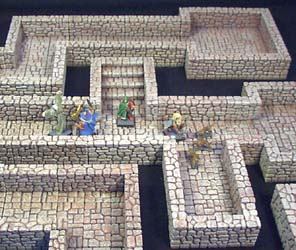
Modular Dungeon Pieces?

 (picture from Hirst Arts website)

Been fooling around with plans for a modular dungeon piece set, and figured out what pieces would be a useful start. But before I begin, better think of the pro's and con's of such a task.

The major pro for dungeon pieces is that they provide a third dimension to the dungeons and ruins (or even space hulks) that the characters and players are exploring. It just looks better than the map drawn out on a dry-erase sheet, especially from a modeller's point of view. Some people I play with just do better with physical representations of combat and such, and an actually 3d representation of such environments is useful.

The two major drawbacks however is the lack of flexibility of pieces and the price tag. With only a set of pieces, you can only arrange the pieces a certain number of ways, or have rooms be only a certain size till you decide to make a new piece to meet the requirements you want. And second, the number of molds to make a plain set (like the picture above) is $80 plus the paints and base materials. To make a decent, and varied set of pieces, you will probably be spending $200 on molds plus all the base materials. Then, the time to cast all the blocks.

Building a dungeon piece set is a lengthen project, but can still merit a sense of accomplishment if done right. But till I can afford it, it's gonna be dry-erase grid sheets.

Monday, December 5, 2011

Encounter Testing

While getting use to the systems, and eager to test out a few random encounters I have. I made a trio of characters to test out things, a mix of everything (except brawn) and been playing though the early level encounters that can occur in the sewers.

The first was 4 dire rats, and it went as expected. Two of the three were diseased, but no real damage was done.

Shit hit the fan when I decide to test out the cockroaches. 6 giant cockroaches versus three adventures... and it was tough. Everyone was knocked down to 2-3 HP and the thief was unconscious. The big thing the cockroaches had on there side was each having 7+ HP and being Die Hard. They will always be at 0 before they die, and that gives each one a last attempt to attack before they die. And I fudge the Die Hard feat since it seems awkward (that is if I read it correctly)... I don't see a cockroach staggering till he reaches -18 HP. So, for creatures and encounters... I'll be treating Die Hard differently... with any blow taking the creature below 0, just takes it to 0 and staggers.

Also, another thing I learn is the cleric's Channel Energy ability. It affects everything within the area... be it friend or foe, living or dead. The user can declare if he/she is affected by it as well. Making my cleric's Channel Negative Energy ability a last ditch ability, unless she's separated from the party. This also makes the other channel feats (like Selective Channeling) pretty useful. But still... 1d6 damage to everything within 30' of a person is a nasty ability at first level.

Last, learning the importance of shakening enemies is important. Let alone, it stacks with frightening and panicking conditions. Plus, growing more familiar with the different conditions, and does make things a bit simpler.

Tuesday, November 1, 2011

Maverick Hunter - Campaign Idea

(Well, after a nostalgia OD this morning... might share this idea.)

(Here is mood appropriate music: )

For the longest time, one campaign I always wanted to run was a campaign taking place in the MegamanX universe in the year 20XX. Characters play as Maverick Hunters, be either a cyborg (like Megaman or Zero) or a regular human aiding in the safety of mankind (like Roll) against the Reploid forces.

The system would be using the BESM system (either 2nd edition or d20) or even Mutants & Mastermind if I ever read over a copy. But the stats and such is pretty simply, with cyborg characters starting with a few traits and the Buster Cannon, while humans have more points to spend on other things like equipment, vehicles, and skills. The idea though is that cyborgs are more the fighters while the human are support characters or specialist fighters (like tank drivers or pilot). And with the characters, all special abilities and attacks are done though machinery; none of the magic/psionic stuff.

And villains all done in traditional MegamanX style, a bunch of animal-themed mavericks with a single mastermind behind the opposition. And beneath theme, the gaggle of robot warmachines and the numerous labor bots turned violate that stand in the way from humanities salvation and demise.

The storyline would be the problem... knowing how the player often deviate form any course plotted by the GM. I'd keep things loose, but like Megaman X flavor, effects will always end up confronting a maverick. He may escape, or may get destroyed... or some events, call on the aid of a 'mini-boss' to help him escape. However, all the mavericks will be created and level up according to the characters. If a player first meets one, the next time they meet him he'll have upgrades to make him an even fight.

And this is a new idea... I got several pages of notes scattered around the room on concepts and such. Personally, mixing Megaman and pen-and-paper RPG seems like the perfect use for the BESM system, and if it ever occurs that I run a BESM campaign, this will be it.